Canada
Northern lights in Whitehorse: clear skies, a step further from the oval
Whitehorse ranks in the top three of our twelve places in every month from September to April. The catch is its position: it needs more solar activity than its northern rivals.
- Best sky: February
- 96% of 5-night stays
- Overhead from Kp 3
- -17 °C on January nights
Most reviewed tour in Whitehorse
Minibus tour
Whitehorse Northern Lights Tour
If no aurora shows: second attempt offered.
If the lights don't appear during the tour, you can contact us, and we'll offer you the opportunity to repeat the tour.
from €111
See dates and price
Links go to Civitatis. Scores are Civitatis customer ratings. Check the listing for the current price and conditions.
Whitehorse: aurora fact sheet
Best month for the sky
February
96% of 5-night stays had at least one usable night. Number 2 of 12 places that month.
Visible from town?
Not verified: every named dark spot, such as Fish Lake, needs a car or a tour
Getting there
Usually via Vancouver, also Calgary or Edmonton; the airport is on the edge of town (YXY)
Cost level
Hotels about USD 107 to 131 a night in February; listed tour from EUR 110.68
Best for
People who want strong sky numbers without the cold of Fairbanks or Yellowknife
- Geomagnetic latitude
- 63.5°
- Kp for overhead aurora
- Kp 3
- Coordinates
- 60.72° N, 135.05° W
What works here
- Top three of our twelve places every month; 96% of five-night February stays had a usable night
- Long season: Travel Yukon dates it from mid-August, and April still has 6.3 dark hours a night
- Milder than Fairbanks or Yellowknife (mean January minimum -18.9 C), with cheap beds in February
What to weigh
- Lowest geomagnetic latitude of our three North American places (about 63.5): needs more activity
- No verified dark spot on foot; Fish Lake and the other named sites need a car or a tour
- No winter international directs confirmed, and no local official forecast or camera
The night sky in Whitehorse, month by month
How dark it gets, how often the cloud opens and what that meant for stays of three, five and seven nights.
- 36%85%Sep9 h1 °C
- 33%83%Oct11 h-5 °C
- 39%85%Nov14 h-14 °C
- 47%94%Dec15 h-16 °C
- 48%93%Jan14 h-17 °C
- 55%96%Feb12 h-16 °C
- 55%95%Mar10 h-14 °C
- 46%91%Apr6 h-7 °C
- Nights with a usable sky
- At least one in 5 nights
- Dark hours per night
- Night temperature
Whitehorse against the others in February
See the full table
| Month | Dark hours per night | Nights with a usable sky | At least one in 3 nights | At least one in 5 nights | At least one in 7 nights | Night temperature |
|---|---|---|---|---|---|---|
| September | 8.6 h | 70% | 85% | 92% | 1 °C | |
| October | 11.4 h | 66% | 83% | 91% | -5 °C | |
| November | 13.8 h | 72% | 85% | 92% | -14 °C | |
| December | 15 h | 82% | 94% | 98% | -16 °C | |
| January | 14.4 h | 82% | 93% | 98% | -17 °C | |
| February | 12.3 h | 85% | 96% | 99% | -16 °C | |
| March | 9.8 h | 86% | 95% | 99% | -14 °C | |
| April | 6.3 h | 79% | 91% | 96% | -7 °C |
A usable sky means at least two dark hours in a row with half the sky or more free of cloud, over an area of about 110 km. It says nothing about solar activity, so it is not the chance of seeing the aurora. How we calculate this
By day in Whitehorse
The nights are long, but the aurora fills a few hours at most. What people do with the rest.
- 1
Yukon Wildlife Preserve
Wildlife park with a 5 km viewing loop, 30 minutes from town. Admission CAD 20; winter bus tours at 12:00 and 15:00 cost CAD 32.
- 2
Eclipse Nordic Hot Springs
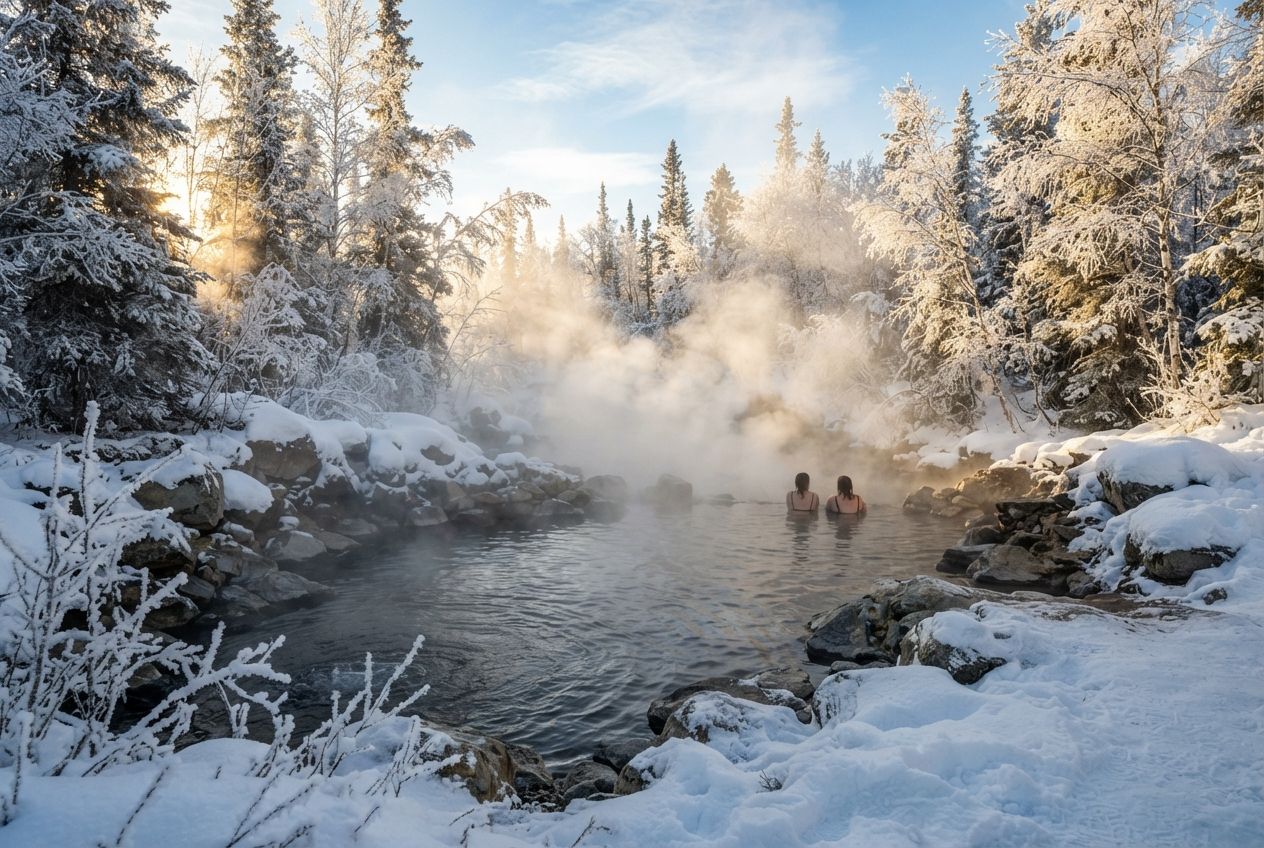
Hot pools and saunas 28 km from downtown, for ages 19 and over. Open daily into the evening; check the current rate before going.
- 3
MacBride Museum
Yukon history museum on Front Street, downtown. Winter hours Tuesday to Saturday 10:30 to 17:00, CAD 12 for adults.
- 4
Yukon Beringia Interpretive Centre
Ice-age natural history centre on the Alaska Highway. From October to April it opens Saturday to Monday, 12:00 to 17:00; CAD 6.
What our sky numbers say about Whitehorse
We count a night as having a usable sky when there were at least two dark hours in a row with half the sky or more free of cloud, averaged over a satellite cell about 110 km across.
Whitehorse is in the top three of the twelve places we cover in every month we measure. February is its best: 55% of nights were usable and 96% of five-night stays had at least one, second only to Yellowknife. October is its weakest month at 83%, and that is still the joint best figure of the twelve for October.
Three nights are a reasonable plan here. In February 85% of three-night stays had a usable night, and in no month was it below 66%. Travel Yukon also suggests a minimum of three. Compare stay lengths on the nights page.
The season is long. Travel Yukon dates it from mid-August, and in April Whitehorse still has 6.3 dark hours a night, the most of the twelve, with 91% of five-night stays getting a usable night.
Seeing the aurora from town
We could not verify a dark spot within walking distance. The places named locally all need a car: Fish Lake, about 25 minutes' drive, the Hidden Lakes, about 1.5 km along Chadburn Lake Road, Schwatka Lake, Grey Mountain and Mount Sima. There is no light measurement for the town, and we found no local official forecast or all-sky camera. Without a car, this means a tour.
Getting there
Whitehorse airport sits on the edge of town. The usual route is via Vancouver, with Calgary and Edmonton as alternatives. We could not confirm the winter 2026/27 schedule with the airlines, and no winter international direct is confirmed, so from Europe expect at least one connection in Canada. A city bus and taxis are reported at the airport. We could not confirm fares (checked 5 October 2026).
What it costs
Beds are cheap for an aurora town. Aggregators put the February average at about USD 107 to USD 131 a night, and February is the cheapest month. Winter clothing rental is roughly CAD 130.
One tour is listed here: a four-hour minibus tour from EUR 110.68 per person, with a score of 9.6 from 11 reviews and free cancellation up to 14 days ahead (checked 5 October 2026). We could not confirm local list prices in Canadian dollars.
Tour or on your own
A tour, unless you hire a car. The listed tour says that if the lights do not appear you can contact the operator and be offered a repeat. That is worth having only with a spare night, which is one more reason to stay at least three. See is a tour worth it.
With a car, Fish Lake Road is the simple choice. The cold is easier than elsewhere in the north: the mean January minimum is -18.9 C, about 8 to 10 degrees milder than Fairbanks or Yellowknife.
"Over 200 nights", checked, and the real catch
Tour packages for Whitehorse advertise over 200 nights of aurora activity a year. No source is given and we found no dataset. Travel Yukon's own page gives no frequency and says there is no guarantee.
The sky is not the weak point. The position is. Whitehorse lies at about 63.5 degrees geomagnetic latitude, against 64.9 for Fairbanks and 68.8 for Yellowknife. Aurora is typically overhead from about Kp 3 here, a cautious figure, compared with Kp 2 and Kp 1. On a quiet night it may sit low on the northern horizon, or not show, while it is overhead at Yellowknife. See how the Kp index works.
So the choice between the three is a trade. Yellowknife and Fairbanks have the position. Whitehorse has the milder cold, a sky that is nearly as clear, and usable nights well into April.
Common questions
What is the best month to see the northern lights in Whitehorse?
February in our 2001-2024 sky data: 96% of five-night stays had at least one dark night with a usable sky, with March at 95% and December at 94%. October is the weakest month at 83%. These figures describe cloud and darkness, not solar activity.
How many nights do I need in Whitehorse?
Three is a reasonable minimum, which is also what Travel Yukon suggests. In February 85% of three-night stays had a usable night, and the lowest monthly figure was 66%, in October.
Can you see the northern lights from downtown Whitehorse?
We could not verify a dark spot within walking distance. The places named locally, such as Fish Lake about 25 minutes away and the Chadburn Lake Road, all need a car, so without one you need a tour.
Is Whitehorse or Yellowknife better for the northern lights?
Their sky numbers are close: 96% against 98% of five-night February stays had a usable night. Yellowknife sits about five degrees higher in geomagnetic latitude, so it needs less solar activity. Whitehorse is much less cold.