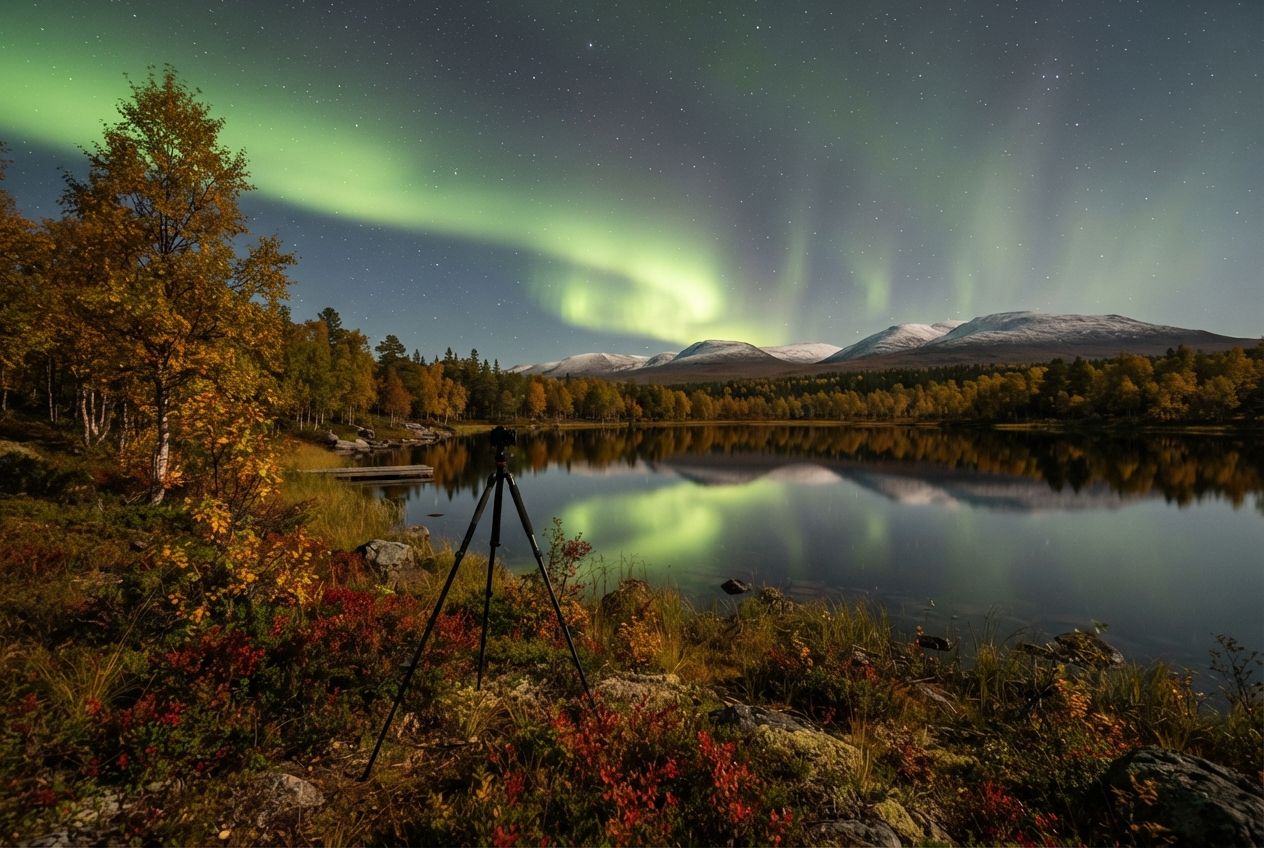
Seeing the northern lights in September
The season is just opening. Nordic nights are still short, and the most dependable sky is in northern Canada.
- Best sky: Yellowknife
- 7 to 9 dark hours
- 12 places compared
Most reviewed tour in Yellowknife
Minibus tour
Northern Lights Trip
If no aurora shows: the listing does not say. Ask before booking.
from €75
See dates and price
Links go to Civitatis. Scores are Civitatis customer ratings. Check the listing for the current price and conditions.
Where to see the northern lights in September
Places are ordered by how often a five-night stay included at least one dark night with a usable sky.
See the full table
| Destination | Dark hours per night | Nights with a usable sky | At least one in 3 nights | At least one in 5 nights | At least one in 7 nights | Kp for overhead aurora | Night temperature |
|---|---|---|---|---|---|---|---|
| 1YellowknifeCanada | 8.3 h | 82% | 94% | 99% | Kp 1 | 6 °C | |
| 2WhitehorseCanada | 8.6 h | 70% | 85% | 92% | Kp 3 | 1 °C | |
| 3LuleåSweden | 7.8 h | 70% | 84% | 90% | Kp 3 | 9 °C | |
| 4KirunaSweden | 7.3 h | 67% | 79% | 86% | Kp 2 | 4 °C | |
| 5FairbanksAlaska, USA | 7.9 h | 60% | 79% | 89% | Kp 2 | 4 °C | |
| 6RovaniemiFinland | 7.7 h | 66% | 78% | 86% | Kp 3 | 7 °C | |
| 7LeviFinland | 7.3 h | 64% | 78% | 86% | Kp 2 | 5 °C | |
| 8SaariselkäFinland | 7.2 h | 60% | 75% | 84% | Kp 2 | 5 °C | |
| 9ReykjavíkIceland | 8.1 h | 51% | 68% | 79% | Kp 2 | 7 °C | |
| 10AkureyriIceland | 7.8 h | 40% | 57% | 69% | Kp 2 | 1 °C | |
| 11TromsøNorway | 6.9 h | 38% | 53% | 65% | Kp 1 | 6 °C | |
| 12AbiskoSweden | 7.3 h | 38% | 52% | 65% | Kp 2 | 2 °C |
A usable sky means at least two dark hours in a row with half the sky or more free of cloud, over an area of about 110 km. It says nothing about solar activity, so it is not the chance of seeing the aurora. How we calculate this
What September is like
Darkness is the limit at the start of the season. Mid-month, the sun stays more than 10 degrees below the horizon for 6.9 hours in Tromsø, 7.3 in Abisko, 7.7 in Rovaniemi, 7.9 in Fairbanks, 8.1 in Reykjavík and 8.3 in Yellowknife. Compare that with 15 to 17 hours in December.
The air is mild: mean temperature during the dark hours is 2C in Abisko, 4C in Fairbanks, 6C in Tromsø and Yellowknife, and 7C in Reykjavík and Rovaniemi.
September is also an equinox month. The Russell-McPherron effect is a statistical tendency for geomagnetic activity to run higher around the equinoxes. The UAF Geophysical Institute says the likelihood over Interior Alaska is roughly twice as high at the equinox as at the solstice. The Finnish Meteorological Institute says only slightly more frequent in spring and autumn. The size is not agreed, and it concerns solar activity, not cloud or darkness. Our figures cover the sky only.
Where the sky is on your side
A usable night, in our statistics, means at least two dark hours in a row with half the sky or more free of cloud, averaged over a satellite cell about 110 km across. By that test Yellowknife is far ahead in September: 94% of five-night stays in Yellowknife had at least one usable night. Whitehorse follows on 85% and Luleå, on the Swedish coast, on 84%, the best Nordic figure of the month. Travel Yukon dates its autumn aurora season from mid-August, so Whitehorse is already dark enough in late August, before our tables start.
The middle of the table is tight. Fairbanks and Kiruna have 79%, Rovaniemi and Levi 78% and Saariselkä 75%, ahead of Reykjavík at 68%. Akureyri (57%), Tromsø (53%) and Abisko (52%) come last.
Spectacular NWT lists mid-August to the end of September as one of the territory's two peak seasons, and Destination Canada flags a cloudier gap from early October to mid-November. Our numbers agree: Yellowknife drops from 94% to 76% in October.
How many nights to plan
In Yellowknife, three nights reach 82% and seven reach 99%. In Rovaniemi the three, five and seven-night figures are 66%, 78% and 86%. In Luleå they are 70%, 84% and 90%. Tromsø needs more patience: 38% for three nights and 65% for seven, which is below what Yellowknife gives in three. The nights calculator covers every combination. These are sky figures; solar activity is covered in when to go.
Is it a good month to book a tour?
It can be, with one caution. Tours are running: Reykjavik Excursions operates from September to mid-April. But with so little darkness, a cloudy first evening costs a larger share of your window than in midwinter. Book the tour for your first night so a retry is possible, and read what happens if no aurora shows before you pay. For the wider question of value, see whether a tour is worth it.
The cards below are for the month's top two places. The Yellowknife minibus trip is from EUR 74.82 per person for four hours and states no policy for a night without aurora. The Whitehorse tour is from EUR 110.68 for four hours and offers a repeat if the lights do not appear. Prices were checked on 5 October 2026.
Tours in the best-placed destinations for September
The two places with the most usable nights this month, with what each listing says about a night without aurora.
Whitehorse
Minibus tour
Whitehorse Northern Lights Tour
If no aurora shows: second attempt offered.
If the lights don't appear during the tour, you can contact us, and we'll offer you the opportunity to repeat the tour.
from €111
See dates and price
Common questions
Can you see the northern lights in September?
Yes, the season has started. Visit Tromsø and Visit Rovaniemi both give late August as the opening, and Explore Fairbanks says 21 August. Whether the aurora is active on a given night is a separate matter from our sky figures.
Is September or March better for the northern lights?
By our sky figures it depends on the place. Yellowknife is level (94% and 95% of five-night stays with a usable night), Rovaniemi is better in March (82% against 78%), and Tromsø is far better in September (53% against 31%). Both are equinox months.
How dark is it in September?
Mid-month, the sun stays more than 10 degrees below the horizon for 6.9 hours in Tromsø and 8.6 in Whitehorse, with the other ten places in between. That is much less than the 15 to 17 hours of December.