Canada
Northern lights in Yellowknife: the best sky we measured
Yellowknife has the highest share of usable nights in our data, in February and in September. You pay for it with distance and the deepest cold of the twelve.
- Best sky: February
- 98% of 5-night stays
- Overhead from Kp 1
- -30 °C on January nights
Most reviewed tour in Yellowknife
Minibus tour
Northern Lights Trip
If no aurora shows: the listing does not say. Ask before booking.
from €75
See dates and price
Links go to Civitatis. Scores are Civitatis customer ratings. Check the listing for the current price and conditions.
Yellowknife: aurora fact sheet
Best month for the sky
February
98% of 5-night stays had at least one usable night. Number 1 of 12 places that month.
Visible from town?
Yes on good nights: Pilots Monument is about a 15-minute walk from downtown
Getting there
Flights from Edmonton, Calgary and Vancouver; no international directs found (YZF)
Cost level
Hotels about CAD 140-200 a night in winter; the listed tour is from EUR 74.82
Best for
People who want the best sky odds and can handle -30 C
- Geomagnetic latitude
- 68.8°
- Kp for overhead aurora
- Kp 1
- Coordinates
- 62.45° N, 114.37° W
What works here
- The best sky we measured: a usable sky on 72% of February nights and in 98% of five-night stays
- Highest geomagnetic latitude of the twelve, about 68.8 degrees: aurora overhead typically from Kp 1
- Walkable viewpoints (Pilots Monument is about 15 minutes from downtown) and a live all-sky camera
What to weigh
- Coldest of the twelve: the mean January minimum is about -29.4 C
- No international direct flights found: you arrive via Edmonton, Calgary or Vancouver
- A cloudier gap in October and November: only 32% and 35% of nights had a usable sky
The night sky in Yellowknife, month by month
How dark it gets, how often the cloud opens and what that meant for stays of three, five and seven nights.
- 48%94%Sep8 h6 °C
- 32%76%Oct11 h-5 °C
- 35%79%Nov14 h-20 °C
- 61%95%Dec15 h-27 °C
- 65%97%Jan15 h-30 °C
- 72%98%Feb12 h-28 °C
- 66%95%Mar10 h-19 °C
- 40%80%Apr6 h-7 °C
- Nights with a usable sky
- At least one in 5 nights
- Dark hours per night
- Night temperature
Yellowknife against the others in February
See the full table
| Month | Dark hours per night | Nights with a usable sky | At least one in 3 nights | At least one in 5 nights | At least one in 7 nights | Night temperature |
|---|---|---|---|---|---|---|
| September | 8.3 h | 82% | 94% | 99% | 6 °C | |
| October | 11.3 h | 62% | 76% | 85% | -5 °C | |
| November | 14 h | 65% | 79% | 87% | -20 °C | |
| December | 15.3 h | 88% | 95% | 98% | -27 °C | |
| January | 14.6 h | 89% | 97% | 99% | -30 °C | |
| February | 12.3 h | 94% | 98% | 99% | -28 °C | |
| March | 9.5 h | 90% | 95% | 98% | -19 °C | |
| April | 5.8 h | 69% | 80% | 86% | -7 °C |
A usable sky means at least two dark hours in a row with half the sky or more free of cloud, over an area of about 110 km. It says nothing about solar activity, so it is not the chance of seeing the aurora. How we calculate this
By day in Yellowknife
The nights are long, but the aurora fills a few hours at most. What people do with the rest.
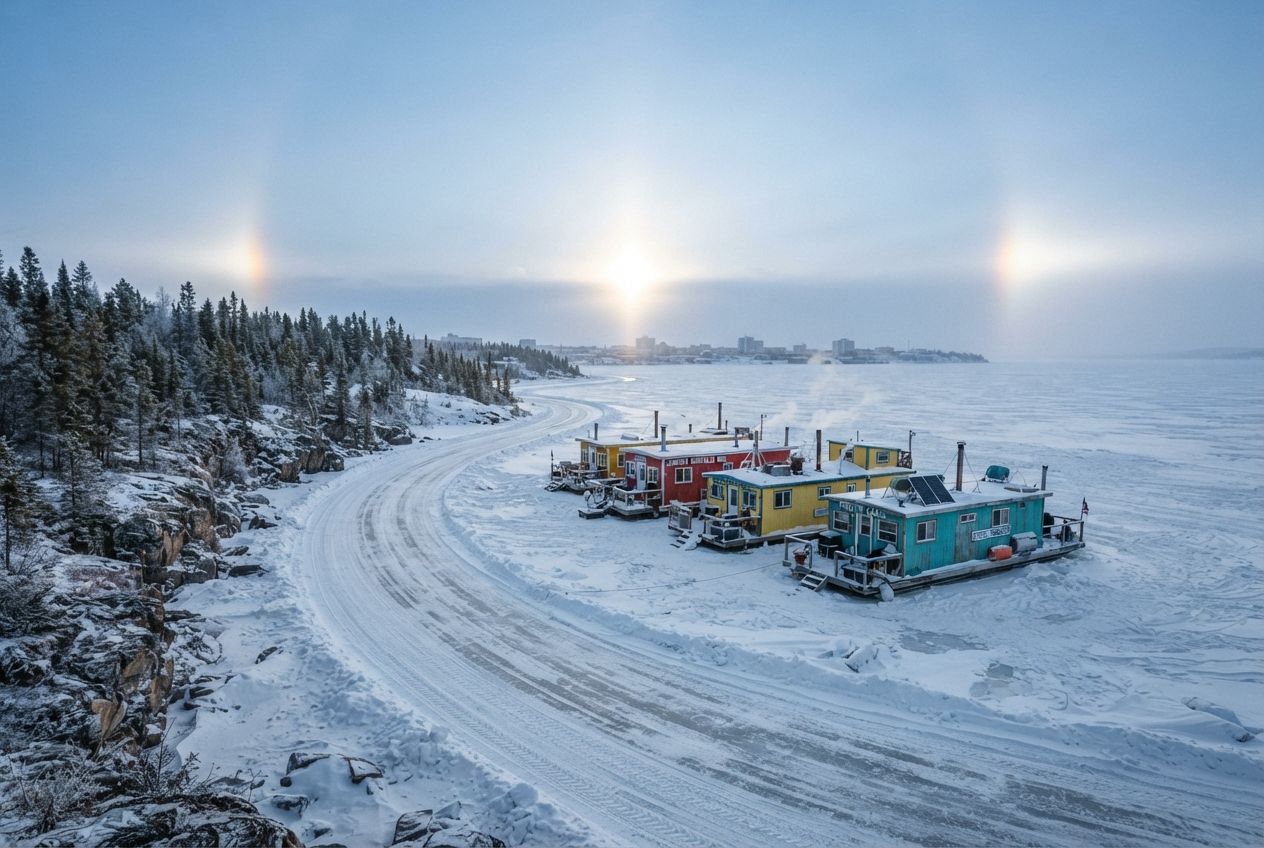
- 1
Prince of Wales Northern Heritage Centre
Territorial museum on Frame Lake, free. Open Tuesday to Sunday 10:00 to 17:00, Thursdays to 20:30, closed Mondays.
- 2
Bush Pilot's Monument in Old Town
Memorial on The Rock, up a wooden staircase with viewing platforms. About a 15-minute walk from downtown. Not wheelchair accessible.
- 3
Yellowknife to Dettah ice road
A 6 km public ice road across Yellowknife Bay to Dettah, a Yellowknives Dene community. On average it opens on 18 December and closes on 19 April.
- 4
Dog sledding on frozen lakes
A guided tour of about 2 hours with about 25 minutes on the sled, from CAD 110 plus 5% tax (North of 60 Aurora Adventures).
What our sky numbers say about Yellowknife
We count a night as having a usable sky when there were at least two dark hours in a row with half the sky or more free of cloud, averaged over a satellite cell about 110 km across. In February and in September no place in our set passes that test more often than Yellowknife.
February is the peak: 72% of nights were usable and 98% of five-night stays had at least one. December, January and March all sit between 95% and 97%. September is the other strong month, with 48% of nights usable and 94% of five-night stays, far ahead of every other place that month.
Between the two there is a dip. October drops to 32% of nights and November to 35%, with five-night figures of 76% and 79%. The national tourism body also describes a cloudier gap from early October to mid-November. Avoid it if you can. Whitehorse, the third North American place on this site, holds up better in those two months, at 83% and 85% of five-night stays.
Three nights is enough for most of the season: 82% of three-night stays in September and 88% to 94% from December to March had a usable night. The nights page has the full table.
These figures describe cloud and darkness. Solar activity is separate, but the position is the best of the twelve: about 68.8 degrees geomagnetic latitude, under or just poleward of the average oval, with aurora typically overhead from Kp 1.
Seeing the aurora from town
Yellowknife is small enough that you can try on foot. A local guide lists Pilots Monument in Old Town, about a 15-minute walk from downtown with an all-round view, and Tin Can Hill, a lookout over Yellowknife Bay.
By car, Fred Henne Territorial Park is about 5 minutes away. The darker sites are along the Ingraham Trail and need a car or a tour: Prosperous Lake, about 24 km out, is where tour buses stop, and Prelude Lake is about 45 minutes away. Aurora Village, a purpose-built viewing site, is about 30 minutes from downtown.
Getting there
Air Canada flies to Yellowknife from Calgary (2 hours), Edmonton (1.5 hours) and Vancouver (2.5 hours). WestJet and Canadian North fly from Edmonton, and Air North from Whitehorse, Toronto and Ottawa. We found no international direct flights and could not confirm winter 2026/27 frequencies. From Europe this means at least two flights.
The airport is about 10 to 15 minutes from town. Taxi fares of roughly CAD 25-35 are quoted online, not confirmed on an official page, and some hotels run free shuttles (checked 4 October 2026).
What it costs
Aggregator examples for winter hotels run about CAD 140-200 a night, highest in February.
Only one tour is listed here: a four-hour minibus trip from EUR 74.82 per person, scoring 8.3 from 6 reviews (checked 4 October 2026). Locally, a small-group chase capped at 12 people was listed at CAD 199 plus 5% tax for the 2025/26 season, and a private vehicle for up to four costs from CAD 600.
Tour or on your own
The sky rarely needs chasing here, so a tour buys two other things: a dark site away from town lights and somewhere warm. At a mean January minimum of about -29 C, the second one counts.
Our pick: take a tour on the first night, then use Pilots Monument or a rental car on the others. The Canadian Space Agency runs a live all-sky camera in Yellowknife, and Astronomy North publishes a daily forecast in season.
The listed tour does not say what happens if no aurora shows. Ask before booking, and read is a tour worth it.
The 240 nights claim, checked
Spectacular NWT, the territorial tourist board, says the Northwest Territories has "up to 240 nights of active Northern Lights per year". Three details matter: "up to", the whole territory, and "active", which is not the same as visible. No source is given. The national tourism body repeats it as an average for Yellowknife.
Mid-August to mid-April is only about 243 nights. So 240 would mean aurora on nearly every dark night, which can only describe activity above the cloud. Our data shows what cloud does to that: usable sky on 72% of February nights and 32% of October nights.
The same board claims a 98% chance over three nights in season, also unsourced. Our three-night sky figure reaches 94% in February and 62% in October. See Fairbanks or Yellowknife for the closest rival.
Common questions
Does Yellowknife really have 240 nights of northern lights a year?
The tourist board's wording is that the Northwest Territories has up to 240 nights of active northern lights a year, with no source given. That describes activity, not sightings. In our data the share of nights with a usable sky ranges from 32% in October to 72% in February.
What is the best month to see the northern lights in Yellowknife?
February for the sky: 72% of nights were usable in our 2001-2024 data and 98% of five-night stays had at least one. September is the best month without deep cold, at 94% of five-night stays.
How cold is Yellowknife in aurora season?
It is the coldest of our twelve. The mean daily minimum is about -29 C in January and -27 C in February. September is mild by comparison, averaging about 6 C during dark hours.
How many nights do I need in Yellowknife?
Three is enough in most of the season. From December to March 88% to 94% of three-night stays had at least one usable night. In October and November plan five.