Alaska, USA
Northern lights in Fairbanks: clear skies and serious cold
From December to March the Fairbanks sky is usable on more than half of all nights. The costs are the flight, the cold and the need for a car or a tour.
- Best sky: January
- 97% of 5-night stays
- Overhead from Kp 2
- -20 °C on January nights
Most reviewed tour in Fairbanks
Day trip with aurora stop
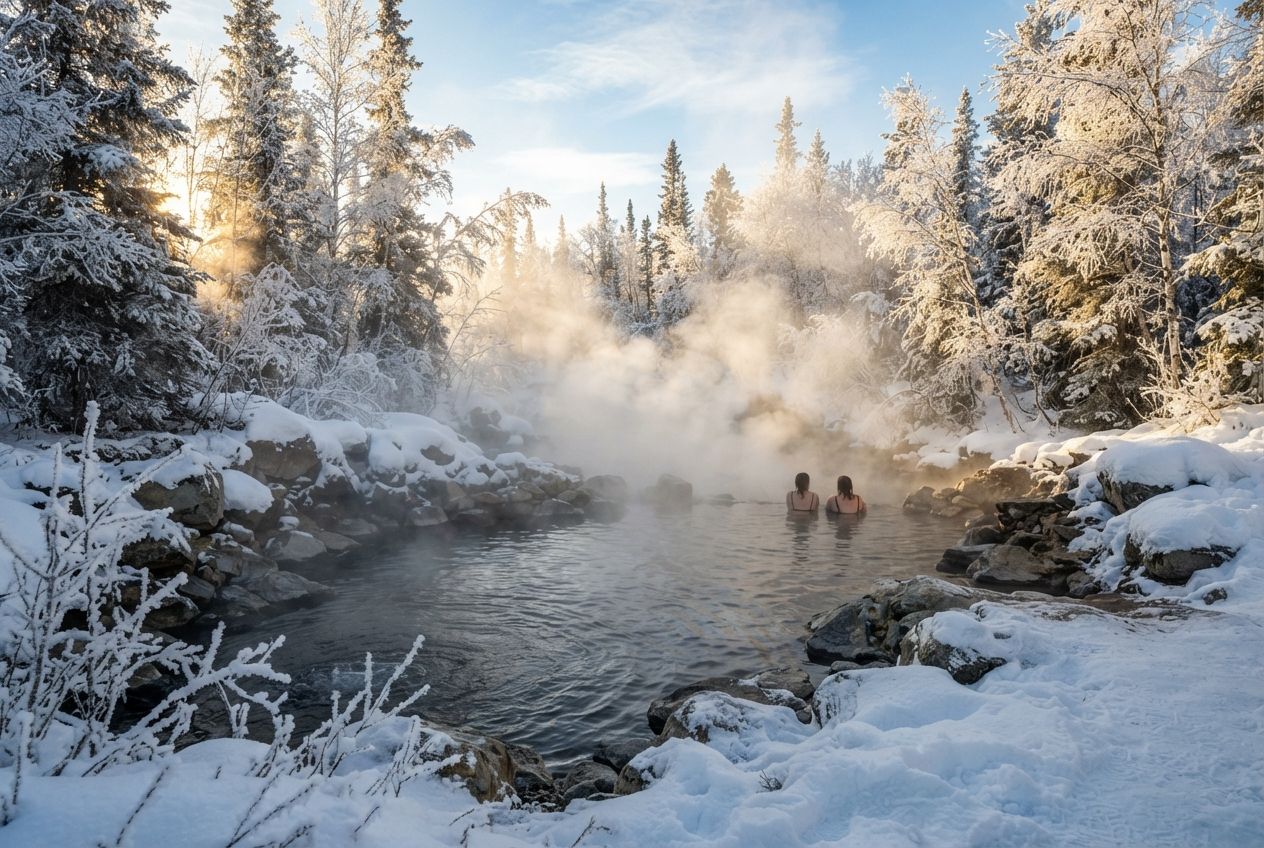
Chena Hot Springs & Northern Lights Tour
If no aurora shows: the listing does not say. Ask before booking.
from €244
See dates and price
Links go to Civitatis. Scores are Civitatis customer ratings. Check the listing for the current price and conditions.
Fairbanks: aurora fact sheet
Best month for the sky
January
97% of 5-night stays had at least one usable night. Number 1 of 12 places that month.
Visible from town?
Barely: Creamer's Field is 2 miles (3 km) from downtown; good sites are 27-40 km out
Getting there
Year-round nonstops from Seattle; from Europe typically via Seattle or Anchorage (FAI)
Cost level
Hotels about USD 100-180 a night in winter; listed tours from EUR 177.66
Best for
North Americans, and Europeans who put sky odds above flight time
- Geomagnetic latitude
- 64.9°
- Kp for overhead aurora
- Kp 2
- Coordinates
- 64.84° N, 147.72° W
What works here
- From December to March more than half of all nights had a usable sky, peaking at 61% in January
- An official list of viewing sites 2 to 25 miles out and a forecast from the University of Alaska
- Moderate winter hotel prices (about USD 100-180 a night) and a stated season of 21 August to 21 April
What to weigh
- Very cold: the mean January minimum is about -27.3 C
- A car or a tour is needed for every viewing site except Creamer's Field
- A long journey from Europe, typically via Seattle or Anchorage
The night sky in Fairbanks, month by month
How dark it gets, how often the cloud opens and what that meant for stays of three, five and seven nights.
- 31%79%Sep8 h4 °C
- 28%74%Oct11 h-5 °C
- 46%88%Nov14 h-15 °C
- 57%96%Dec16 h-18 °C
- 61%97%Jan15 h-20 °C
- 55%95%Feb12 h-17 °C
- 58%92%Mar9 h-16 °C
- 49%84%Apr5 h-6 °C
- Nights with a usable sky
- At least one in 5 nights
- Dark hours per night
- Night temperature
Fairbanks against the others in January
See the full table
| Month | Dark hours per night | Nights with a usable sky | At least one in 3 nights | At least one in 5 nights | At least one in 7 nights | Night temperature |
|---|---|---|---|---|---|---|
| September | 7.9 h | 60% | 79% | 89% | 4 °C | |
| October | 11.4 h | 58% | 74% | 85% | -5 °C | |
| November | 14.3 h | 75% | 88% | 94% | -15 °C | |
| December | 15.8 h | 87% | 96% | 99% | -18 °C | |
| January | 14.9 h | 89% | 97% | 99% | -20 °C | |
| February | 12.4 h | 84% | 95% | 98% | -17 °C | |
| March | 9.3 h | 83% | 92% | 95% | -16 °C | |
| April | 5 h | 75% | 84% | 87% | -6 °C |
A usable sky means at least two dark hours in a row with half the sky or more free of cloud, over an area of about 110 km. It says nothing about solar activity, so it is not the chance of seeing the aurora. How we calculate this
By day in Fairbanks
The nights are long, but the aurora fills a few hours at most. What people do with the rest.
- 1
University of Alaska Museum of the North
On the university campus. Adult USD 23, youth 6 to 17 USD 15. Winter hours are daily 09:00 to 17:30.
- 2
Morris Thompson Cultural and Visitors Center
Free visitor centre with an exhibit on Interior Alaska life and Alaska Native culture. Weekdays 08:00 to 17:00, weekends 10:00 to 17:00.
- 3
Chena Hot Springs and Aurora Ice Museum
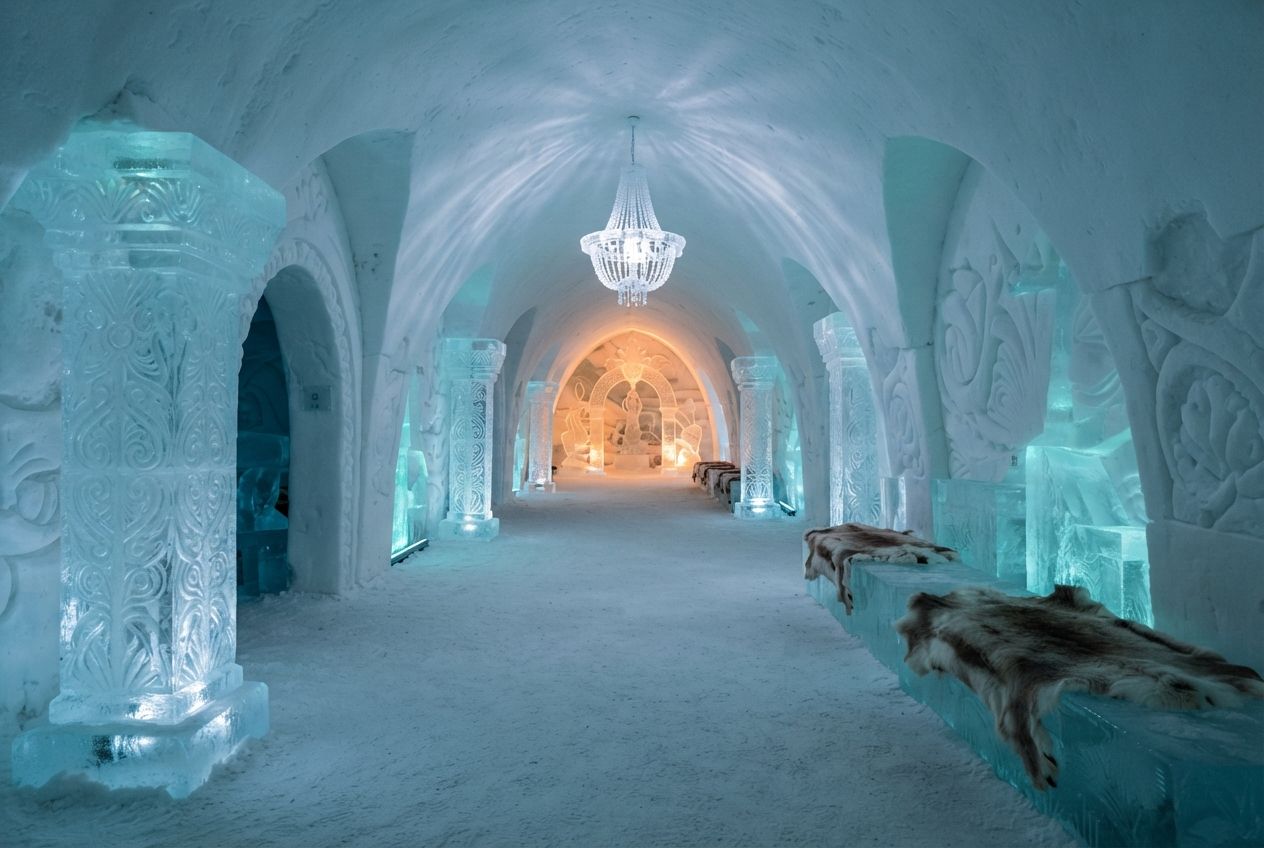
Geothermal resort about 60 miles (97 km) from Fairbanks with a year-round ice museum. Museum tours run at 11:00, 13:00, 15:00, 17:00 and 19:00.
- 4
Dog mushing rides and kennel tours
Rides of 30 minutes or longer, one-hour and half-day tours from kennels around Fairbanks. They depend on snow.
What our sky numbers say about Fairbanks
Our test for a usable sky is a night with at least two dark hours in a row and half the sky or more free of cloud, averaged over a satellite cell about 110 km across. In mid-winter Fairbanks, Yellowknife and Whitehorse pass it far more often than any European place on this site.
From December to March more than half of all nights were usable, peaking at 61% in January. In those four months 92% to 97% of five-night stays had at least one usable night. November is a step down at 88%. September and October are the weak end: 79% and 74%, with 28% of October nights usable.
Fairbanks also keeps going late. April still has 5 dark hours a night and 84% of five-night stays had a usable night, second only to Whitehorse's 91%.
In mid-winter three nights is a reasonable plan: 84% to 89% of three-night stays from December to February had a usable night. In September or October book five. Every month is on the nights page.
These are sky statistics. Solar activity is separate. Fairbanks sits at about 64.9 degrees geomagnetic latitude, with aurora typically overhead from Kp 2.
Seeing the aurora from town
Not really, and this is the main practical difference from Yellowknife. Explore Fairbanks names one viewing site near town: Creamer's Field, 2 miles (about 3 km) from downtown, with paved access.
The others need a vehicle. Chena Lake Recreation Area is 17 miles (27 km) out. Cleary Summit is 20 miles (32 km) away at 2,233 ft (680 m), and Murphy Dome is 25 miles (40 km) away at 2,877 ft (877 m). The tourist board advises all-wheel or four-wheel drive for both hills in winter. We found no public transport to any of them.
Getting there
Fairbanks International has year-round nonstop flights from Seattle on Alaska Airlines and Delta. In winter there are seasonal charters from Japan and Taipei. The Condor flight from Frankfurt is summer only, so from Europe you typically connect in Seattle or Anchorage. We could not confirm winter 2026/27 frequencies.
The airport is about 10 to 20 minutes from town. Taxi fares quoted online range from roughly USD 15 to 35, and we could not confirm a figure on an official page (checked 4 October 2026).
What it costs
Hotels are the cheap part. Aggregator examples for winter run about USD 100-180 a night.
Tours are not cheap. The three listed here start from EUR 177.66 per person for a five-hour evening at a viewing lodge, EUR 244.29 for a 17-hour day with Chena Hot Springs and EUR 322.46 for a 15-hour Arctic Circle trip (checked 4 October 2026). Review counts are low, between 3 and 8 each.
Tour or on your own
With a rental car and winter driving experience, go on your own. Cleary Summit and Murphy Dome are free, and the University of Alaska's Geophysical Institute publishes a three-day forecast. It gives 9 pm to 3 am as the hours with the higher probability.
Without a car, take the lodge tour. At a mean January minimum of about -27 C, a warm building matters.
None of the three listings says what happens if no aurora shows, and one local operator we found states plainly that there is no refund. Here that is less of a worry than in Tromsø, because the sky so rarely shuts you out for a whole stay. See is a tour worth it.
The 90% in three nights claim, checked
Explore Fairbanks says visitors who stay at least three nights and are "actively out during the late evening hours" raise their chance of seeing the aurora to more than 90 percent. It cites no dataset or method. The Geophysical Institute's version carries no number: if the weather is clear and you stay three nights, a sighting is highly likely but never certain.
Note the two conditions, being outside late and clear weather. Our data covers the second. In no month did three-night stays reach 90% for a usable sky. January came closest at 89%. October managed 58%.
So the claim is plausible for mid-winter and too generous for autumn. For five nights from December to March, our sky figures pass 90% on their own. Fairbanks or Yellowknife sets the two side by side.
More northern lights tours in Fairbanks
Viewing lodge
Fairbanks Aurora Viewing Lodge Experience
If no aurora shows: the listing does not say. Ask before booking.
from €178
See dates and priceDay trip with aurora stop
Arctic Circle & Northern Lights Tour
If no aurora shows: the listing does not say. Ask before booking.
from €322
See dates and price
Common questions
Is it true you have a 90% chance of seeing the aurora in Fairbanks in three nights?
That is a claim by Explore Fairbanks, the tourist board, for visitors who stay at least three nights and are out in the late evening. No dataset is published. In our sky data the best three-night figure is 89% of stays with a usable night, in January, before solar activity is counted.
What is the best month to see the northern lights in Fairbanks?
December to March for the sky. In our 2001-2024 data 92% to 97% of five-night stays in those months had at least one dark night with a usable sky. September and October are the weakest, at 79% and 74%.
Can you see the northern lights from Fairbanks without a car?
Only just. Creamer's Field, 2 miles (3 km) from downtown, is the one named viewing site close to town. The better sites are 17 to 25 miles (27 to 40 km) out, and we found no public transport to them, so you need a rental car or a tour.
How cold is Fairbanks during aurora season?
Very. The mean daily minimum is about -27 C in January and about -20 C in November and March. Tours that include a heated lodge exist for that reason.